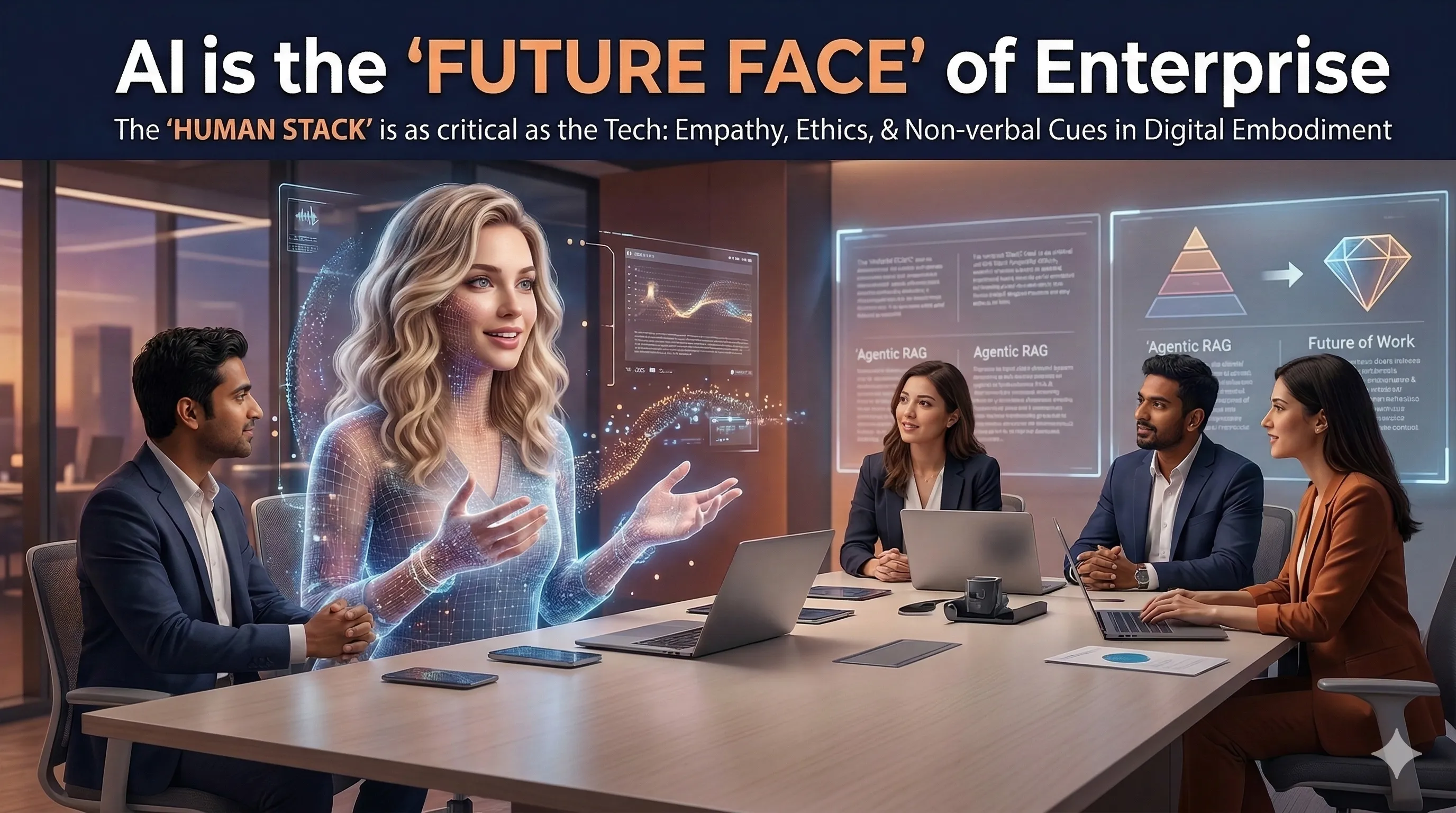
The Race for the Digital Face: Why Non-Verbal Cues are the Next Frontier in Agentic AI
In an era where large language models have mastered the art of text, a new frontier is emerging: the humanization of artificial intelligence through digital avatars. From reducing cognitive friction in customer service to preserving the expertise of a retiring workforce via digital twins, the integration of faces and voices into AI is no longer a gimmick—it is a strategic imperative. To explore this shift, we sat down with Vaibhav, a specialist working deep within the field of digital embodiment, to discuss the complex orchestration of engineering and psychology required to build the future of human-AI interaction.
Research suggests that human trust is often established within the first 100 milliseconds of an interaction. Why is there such a sudden race to give AI a face, especially when text-based models are already so advanced?
The answer lies exactly in that 100-millisecond window. In that initial flash, our brains aren’t processing voice or content; they are processing visual cues. Attaching a face to AI reduces “cognitive friction,” giving the brain a character it can get comfortable with. Furthermore, 70% of communication is non-verbal. While millennials might be a “text-first” generation, Gen Z and Alphas are growing up in sensory-rich environments where communication via voice and gesture is the norm. Even for complex fields like finance or healthcare, engagement rates can triple when a facial element is attached.
The digital stack consists of four layers: speech-to-text, the AI processing layer (LLMs), text-to-speech, and finally the rendering layer where diffusion models create the avatar and lip-sync. You’ve described a “human stack” that mirrors the digital technology stack. How do these layers actually work together to create a relatable persona?
The human stack focuses on the brain (content and context), the voice, and the expressions. We are now seeing “emotion-to-voice” technology where avatars don’t just read text; they modulate their tone and use micro-expressions—like raising an eyebrow or nodding—to replicate human-like interaction. This allows a brand’s avatar to become a living embodiment of its ethos rather than just a static logo.
As organizations deploy these autonomous agents, we’re seeing traditional “pyramid” structures evolve into “diamonds”. What does this mean for the future of the workforce?
It’s a clear reflection of how work will be delivered. The bottom of the org is being replaced by agents who can handle significantly more volume than humans. This leaves middle management to play the crucial role of managing these agents, while senior management focuses on strategy. Despite fewer humans in the organization, the customer experience actually becomes more personalized because agents can leverage hyper-personalized data at scale.
Beyond customer service, what are some of the more “human-centric” use cases for this technology?
We are seeing two ends of the spectrum. For the younger workforce, avatars act as “shadow mentors” or mock interviewers, providing a safe, repetitive environment to practice difficult conversations. On the other hand, for the retiring workforce in aging economies like North America and Europe, we can create “digital twins” of veteran workers. This allows an organization to retain not just static playbooks, but the actual process and mentorship style of their most experienced people. I’m even working on a project using avatars to help neurodivergent children practice job interviews through patient, infinite repetition.
What are the primary technical and social hurdles we still need to clear?
Latency is a major barrier; research shows a lag of more than two seconds destabilizes a conversation between an avatar and a human. We are looking to move from a four-layer stack to a two-layer stack where AI directly processes audio without converting it to text first. Socially, “parasocial risks”—like falling in love with or becoming addicted to AI—are genuine concerns. Organizations must be transparent that these are technological constructs. We also face technical “AI loops” and hallucinations, which we are now combating by deploying “supervisory agents” to pre-empt and rectify errors.
Finally, what is your advice for the younger generation entering this “agent-led” workforce?
Agent management is no longer just a niche job vertical; it is becoming a horizontal skill required in every part of the knowledge economy. You might be hired for a job and expected that by the third month you are automating it, and from the fourth month onward you are managing the agent. The “competitive moat” for humans will be the things AI cannot replicate: high ethical standards, empathy, and the ability to ensure agents don’t become “spammy” or biased.
Referenced Works & Contextual Reading
-
“The Adolescence of Technology”: An essay by Dario Amodei (referenced) discussing the risks and social fabric changes brought by powerful AI.
-
“Observability in 2026”: IBM research highlighting observability as a critical priority for managing bots, avatars, and digital twins.